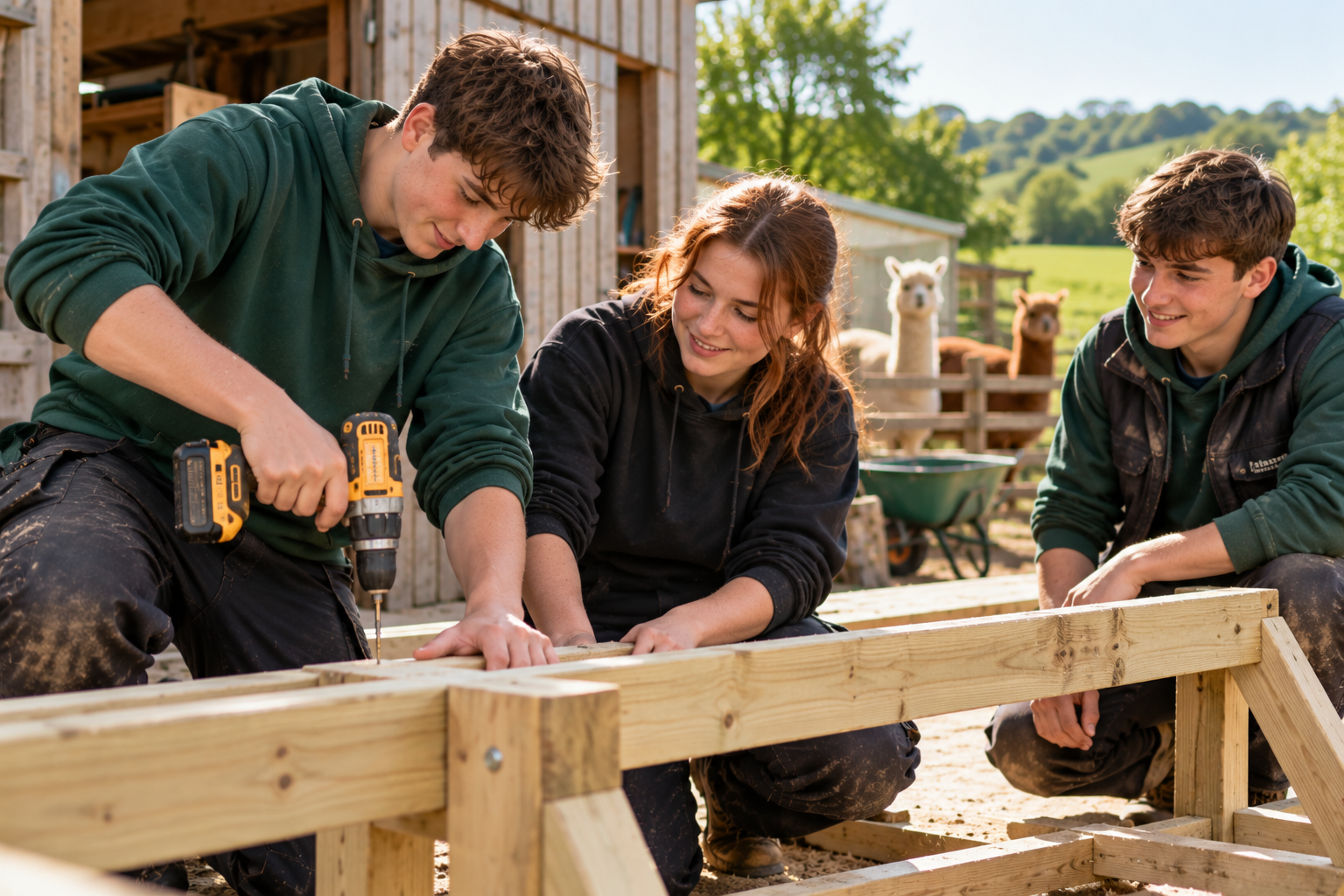
Our Skills for the Future programme offers young people the opportunity to work towards two recognised City & Guilds qualifications, combining a practical vocational course with an Employability Skills qualification.
Learners choose a vocational pathway in Animal Care, Horticulture or Land-Based Construction, alongside a separate Employability Skills course designed to develop communication, teamwork, independence and workplace readiness.
This combined approach helps young people gain practical knowledge and recognised qualifications while developing the essential skills needed for further education, training and future employment.
Skills for the Future is a structured learning programme that combines practical vocational education with employability skills, giving young people the opportunity to work towards two separate, recognised City & Guilds qualifications.
Learners follow a vocational pathway in Animal Care, Horticulture or Land-Based Construction alongside a separate Employability Skills qualification. This approach allows learners to develop specialist practical knowledge while gaining essential skills for further education, training and employment.
Learners work towards a City & Guilds qualification in their chosen subject, developing practical skills and knowledge through hands-on activities within our working farm environments.
Alongside their vocational studies, learners work towards a separate City & Guilds Employability Skills qualification, developing communication, teamwork, problem-solving, independence, personal responsibility and workplace readiness.
Both qualifications are assessed and awarded separately, allowing learners to gain recognition for their achievements in each area.
Skills for the Future is designed for young people who benefit from a practical, supportive approach to education, including:
Each learner's suitability and qualification pathway are considered individually, taking into account their age, abilities, interests, support needs and future goals.
Skills for the Future combines a vocational qualification in Animal Care, Horticulture or Land-Based Construction with a separate Employability Skills qualification.
Learners develop practical knowledge and specialist skills in their chosen vocational subject while also studying essential workplace skills, including communication, teamwork, problem-solving and personal responsibility.
The level of each qualification is selected according to the learner's age, abilities, previous experience and individual progression goals.
Develop knowledge and practical skills in animal health, welfare, feeding, handling, husbandry and safe working practices.
Gain experience in planting, growing, maintaining outdoor spaces, caring for plants and using horticultural tools safely.
Develop practical skills through woodworking, construction projects, tool use and maintaining structures within a working farm environment.
Alongside their chosen vocational pathway, all learners study a separate City & Guilds Employability Skills qualification.
This develops essential skills for education and employment, including communication, teamwork, problem-solving, time management, following instructions, personal responsibility and understanding workplace expectations.
Skills for the Future provides opportunities to work towards two separate City & Guilds qualifications: one vocational qualification and one Employability Skills qualification.
Depending on the individual pathway, qualifications may be available at Entry Level, Level 1, Level 2 or Level 3, subject to course availability, age restrictions and qualification requirements.
Each qualification is assessed and awarded separately. The appropriate levels are agreed individually, taking into account the learner's abilities, previous experience and readiness to meet the assessment criteria.
Our Skills for the Future programme offers flexible learning arrangements designed to support individual needs and educational goals.
Practical farm-based sessions where learners develop vocational skills while building confidence, communication and teamwork.
Individual sessions providing additional support, with activities adapted to the learner's abilities, confidence and learning needs.
Structured part-time attendance combining practical learning, personal development and opportunities to work towards recognised qualifications.
Learning takes place through a combination of practical activities, tutor demonstrations, supported theory sessions and real-life tasks within the farm environment.
Where learners are working towards qualifications, assessment may include practical observations, verbal questioning, written activities and other evidence appropriate to the qualification requirements.
Reasonable adjustments and individual support are provided where appropriate, while ensuring learners meet the required qualification standards.
Our aim is to help learners develop confidence and independence while recognising their individual strengths and achievements.
Skills for the Future helps learners prepare for their next steps, which may include:

Further Vocational Qualifications
Progress towards higher-level City & Guilds qualifications in animal care, horticulture, construction or employability skills.

Further Education & Training
Develop the confidence, knowledge and skills needed to access further education, apprenticeships or vocational training.

Employment & Volunteering
Build practical experience and workplace skills that support future employment, volunteering or supported employment opportunities.
Progression opportunities depend on individual achievements, abilities and readiness for the next stage.

Practical Education Beyond the Classroom
Providing practical, farm-based education, recognised qualifications and alternative learning opportunities at Frampton Farm in Kent and Poppies Farm in Berkshire, helping young people develop confidence, independence and skills for the future.
Access course materials, complete theory activities and keep up with your learning using Moodle.
Download the Moodle app for your phone or tablet.


Fees & Funding
Programme Fees
Fees vary depending on the learning centre, attendance arrangements, selected qualifications and level of individual support required.
We can discuss suitable programme options and provide a personalised quotation based on the learner's requirements.
Please contact us for information about current fees and availability at Frampton Farm or Poppies Farm.
Privately Funded Places
Parents and carers can enquire about privately funded places, with attendance and payment arrangements agreed before enrolment.
School & Local Authority Funding
Programmes may also be commissioned by schools, local authorities and other education providers as part of a young person's educational arrangements.
This may include alternative provision, vocational learning alongside school attendance or agreed Education Otherwise Than At School (EOTAS) provision.
Any placement and associated funding must be approved by the relevant commissioning organisation.
Enquire About Fees
Please contact us to discuss programme availability, attendance options and fees at Frampton Farm or Poppies Farm.