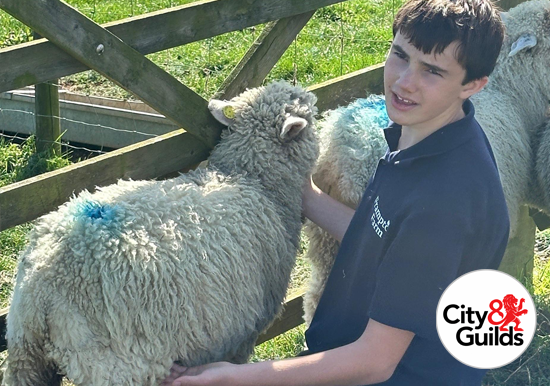
Our City & Guilds Level 1 Certificate in Work-Based Animal Care develops the knowledge and practical skills needed to assist with everyday animal care in a working farm environment.
Through personalised one-to-one tuition, learners gain experience of animal welfare, accommodation, safe livestock handling, small-animal feeding and workplace safety. Practical activities are supported by tutor-led learning, discussion and portfolio evidence.
Learners can study the Certificate directly or build on units achieved through our Level 1 Award, subject to City & Guilds registration and recognition arrangements.
The Level 1 Certificate in Work-Based Animal Care is a nationally recognised City & Guilds qualification comprising nine units and 18 credits. It combines practical work with underpinning knowledge, helping learners understand how to carry out animal care tasks safely and responsibly.
Individual sessions provide opportunities to develop confidence, communication, responsibility and workplace skills through supervised activities with animals at the farm.
Learners interested in practical animal care and farm-based vocational education.
Home-educated learners or young people who benefit from personalised, one-to-one learning.
Learners wishing to develop workplace readiness, independence and practical husbandry skills.
Learners who have completed our Level 1 Award and wish to continue towards the Certificate.
No previous animal care qualification is required. Each application is considered individually, taking account of age, readiness to work safely around animals, learning needs and suitability for the assessment requirements.
Eligibility and any applicable City & Guilds registration requirements will be confirmed before enrolment.
Successful learners may progress to a suitable Level 2 Animal Care qualification or other vocational education, subject to entry requirements and individual readiness.
The Certificate combines practical and knowledge-based units. Our selected farm animal handling route includes the following nine units, totalling 18 credits.
Recognise workplace hazards, use protective equipment, prepare and maintain safe work areas, follow instructions and respond appropriately to emergencies.
Assist with animal health and welfare monitoring, feeding, watering and reporting concerns under supervision.
Understand animal welfare, signs of health and ill health, stress, preventative care and appropriate feeding and watering.
Understand how animal housing is prepared, cleaned and maintained, including safe waste disposal and welfare requirements.
Prepare, clean, check and maintain animal accommodation, reporting hazards and protecting animal welfare.
Assist with moving and handling suitable livestock calmly and safely, following instructions and observing animal responses.
Understand livestock behaviour, handling methods, risks and safe movement procedures.
Learn about receiving, checking, storing and preparing small-animal feeds, including hygiene, stock rotation and pest prevention.
Practise checking feed deliveries, safe storage, feed preparation, hygiene and the use of feeding plans for small animals.
Learners practise skills through supervised daily husbandry, animal observations, accommodation care, safe livestock handling and small-animal feeding tasks. They also develop understanding through tutor discussion, guided activities and portfolio work.
The Certificate is offered through individual farm-based tuition, with a minimum of six hours per week over one academic year. Start dates are flexible, subject to availability and learner suitability.
Sessions combine practical farm activities, guided theory, discussion and collection of work-based assessment evidence. Learning is adapted to the individual while maintaining the required standards.
Learners who have completed our Level 1 Award may continue towards the Certificate in a second year. The additional units are 101, 110 and 111, provided previous unit achievements are accepted by City & Guilds. Attendance and duration for this progression route will be agreed individually.
Assessment is based on a portfolio of work-based evidence. This may include direct practical observations, assessor records, professional discussion, questions and other suitable evidence of the required knowledge and skills.
The qualification is graded Pass or Fail. Learners must meet all required assessment criteria, with appropriate reasonable adjustments considered where permitted.
After successfully completing the Level 1 Certificate, learners may be able to progress to:

Develop further knowledge and practical skills in animal health, welfare, feeding and husbandry.
Click to read more

Explore a related qualification focused on safe working and farm livestock care.
Click to read more

Consider species-focused vocational learning, subject to the entry requirements.
Click to read more
Explore further vocational education, supported volunteering or suitable animal care opportunities.
Click to read more
Progression depends on each learner's achievements, abilities, interests and readiness for the next level.

Practical Education Beyond the Classroom
Providing practical, farm-based education, recognised qualifications and alternative learning opportunities at Frampton Farm in Kent and Poppies Farm in Berkshire, helping young people develop confidence, independence and skills for the future.
Access course materials, complete theory activities and keep up with your learning using Moodle.
Download the Moodle app for your phone or tablet.


Fees & Funding
Course Fees
Fees depend on the learning centre and individual support arrangements. The full Certificate is delivered one-to-one for a minimum of six hours per week, with fees and payment arrangements confirmed before enrolment.
City & Guilds registration and certification charges may apply.
Privately Funded Places
Parents, carers and individual learners may enquire about privately funded places, subject to availability and suitability.
School & Local Authority Funding
Schools and local authorities may commission individual placements as part of vocational education, alternative provision or an agreed EOTAS package. Any funding must be agreed with the commissioning organisation.
Enquire About Fees
Please contact your preferred learning centre for fees, availability and arrangements for learners progressing from the Award.