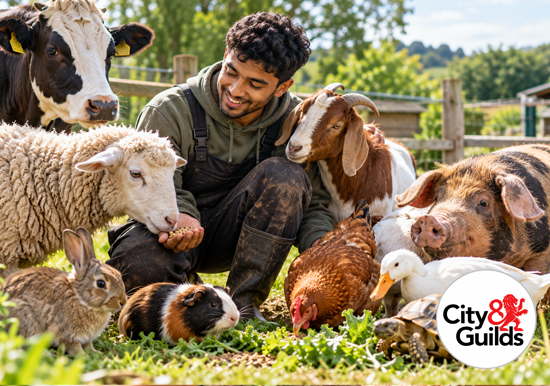
Develop practical skills and specialist knowledge across six animal groups: sheep, goats, pigs, poultry, cattle and small mammals. Each term focuses on one animal group, with theory, supervised practical learning and an individual assessment.
Each animal specialism leads to its own separately awarded City & Guilds Level 2 Certificate of Technical Competence in Animal Health, Husbandry and Handling (0146-22). The six certificates form our centre-designed programme, not a single combined City & Guilds qualification.
Our structured, one-academic-year programme offers six separate species-endorsed City & Guilds Level 2 Certificates. Learners study one animal group per term and build practical confidence in animal housing, feeding, behaviour, handling, health and welfare.
Suitable for learners aged 16+ interested in smallholding, livestock care, animal-related employment or broadening their existing animal care studies. Each learner’s experience, support needs and ability to work safely with animals are considered before enrolment.
Each animal group is assessed separately. Learners who successfully complete all six assessments can receive six individual certificates, endorsed for Sheep (904), Goat (906), Pig (905), Poultry (907), Cattle (903) and Exotic Pets – Small Mammals (908).
Learners may also enquire about studying an individual species certificate rather than the full programme, subject to places, assessment arrangements and centre availability.
Our proposed teaching sequence follows the six terms of the academic year. The order may change to reflect animal welfare, seasonal husbandry and assessment opportunities.
Flock housing, feeding, behaviour, health checks, handling and routine husbandry.
Goat accommodation, nutrition, social behaviour, safe handling, preventative care and welfare.
Pig housing, feeding, group behaviour, health monitoring, safe movement and husbandry.
Coop and run management, feed and water, flock behaviour, handling, health checks and hygiene.
Cattle housing, nutrition, herd behaviour, safe handling and movement, basic health checks and welfare.
Species-appropriate housing, feeding, social needs, handling, health checks and welfare, using suitable small mammals such as rabbits and guinea pigs.
Each certificate requires the same unit to be taught and assessed in the relevant animal context. Learning covers preparing and maintaining housing, providing diets, understanding social groupings, carrying out husbandry tasks and understanding ethical responsibilities.
Small-group learning: three-hour weekly sessions across one academic year, focusing on one animal group per term.
One-to-one learning: personalised three-hour weekly tuition, subject to arrangements and availability.
Hybrid learning: supported remote theory combined with scheduled in-person practical teaching and assessment. These qualifications cannot be completed entirely online.
Each individual certificate has 14 guided learning hours (GLH) and 16 total qualification hours (TQT). Across six separate certificates this represents 84 GLH and 96 TQT. A typical six-week term at three hours per week provides around 18 scheduled session hours, allowing flexibility for teaching and assessment; actual contact and guided hours will be recorded appropriately.
For each animal group, City & Guilds requires a one-to-one practical assessment with oral questioning. Learners must demonstrate the required skills and knowledge in the specific animal context. Each certificate is graded Pass only.
Animal welfare, safe working and appropriate support are central to all practical activities. Employer involvement must be planned and recorded for every learner in accordance with qualification requirements.
Fees for the full six-certificate programme depend on the learning option, centre and any individual support or assessment arrangements. Please contact us for a quotation showing course fees and any City & Guilds registration and certification charges.
Enquiries for a single animal specialism are welcome, subject to available places and scheduling.
Suitable for privately funded learners, smallholders and those wishing to develop practical animal care skills.
Commissioned places may be considered where suitable for an agreed vocational education programme.
Contact Frampton Farm in Kent or Poppies Farm in Berkshire to discuss availability and practical arrangements.
Explore individual specialist certificates and further animal care qualifications.

Choose a specific animal group or explore additional species endorsements beyond the six-certificate programme.

Broaden knowledge and practical skills through a larger animal care qualification.

Progress to higher-level study when ready for more advanced animal management learning.

Practical Education Beyond the Classroom
Providing practical, farm-based education, recognised qualifications and alternative learning opportunities at Frampton Farm in Kent and Poppies Farm in Berkshire, helping young people develop confidence, independence and skills for the future.
Access course materials, complete theory activities and keep up with your learning using Moodle.
Download the Moodle app for your phone or tablet.