Develop practical farm animal care skills alongside ICT, independent project work and enterprise activities. This City & Guilds qualification combines meaningful hands-on experience with supportive classroom learning and assessment.
Designed with younger learners in mind, typically aged 11–13, the course helps build confidence, responsibility, communication and practical skills in a real working farm environment.
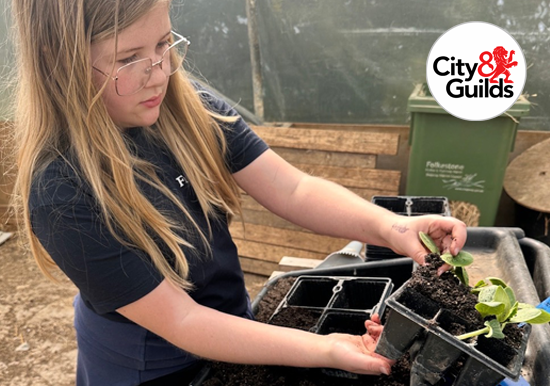
Our Entry Level 2 Certificate in Skills for Working Life – Land Based (Land and Plants) introduces younger learners to horticulture and conservation through practical, supervised activities on the farm.
Learners develop confidence and useful everyday skills while exploring plants, growing, garden maintenance, wildlife habitats and safe working practices. The selected programme includes 13 units totalling 23 credits.
We recommend this course for learners aged approximately 9 years + who enjoy outdoor learning, gardening, nature and practical activities. It may suit home-educated learners and those who benefit from a supportive, hands-on approach.
No previous qualifications are required. Suitability is considered individually, including each learner's interests, support needs and ability to participate safely and achieve the assessment criteria with appropriate guidance.
After completing the course, learners may progress to our Entry Level 3 Horticulture & Conservation pathway or other suitable land-based qualifications, depending on their readiness and interests.
Our programme combines four preparing-for-work units (8 credits) with nine practical horticulture and conservation units (15 credits).
Unit 201 – Workplace Safety and Emergency Procedures (1 credit): Understand basic safety rules and what to do in an emergency.
Unit 203 – Identify Hazards in Familiar Settings (2 credits): Recognise everyday hazards in growing areas and other familiar environments.
Unit 207 – Effective Communication (2 credits): Develop communication skills through discussions, shared tasks and practical activities.
Unit 209 – Introduction to ICT (3 credits): Build basic computer skills and use ICT for suitable learning activities.
Unit 235 – Recognise Trees and Plants (1 credit): Identify familiar trees and plants around the farm.
Unit 236 – Recognise, Use and Care for Tools Used in Conservation (2 credits): Learn to identify and safely use suitable hand tools.
Unit 238 – Plant an Area to Attract Wildlife (2 credits): Help create an area that supports wildlife.
Unit 239 – Recognise Plants (1 credit): Identify common plants and their characteristics.
Unit 240 – Recognise, Use and Care for Tools Used in Horticulture (2 credits): Select, use and look after suitable gardening tools.
Unit 241 – Prepare and Plant an Area (2 credits): Prepare soil and plant an area using appropriate methods.
Unit 242 – Weed a Planted Area (2 credits): Recognise and remove weeds safely while caring for planted areas.
Unit 243 – Fill Plant Containers (1 credit): Prepare containers and growing media for planting.
Unit 219 – Maintain a Fence (2 credits): Assist with appropriate, age-suitable fence maintenance under supervision.
Learners use the farm's growing areas and outdoor spaces to practise skills through short teaching activities, demonstrations and supervised tasks. Activities are adapted to the season and learners' abilities, while meeting each unit's assessment requirements.
Attend one day per week at the farm over an academic year, combining short classroom activities with practical gardening, conservation, ICT and portfolio work. Timetables are confirmed before enrolment.
Personalised sessions may be available for learners who benefit from additional support or a quieter environment. Attendance is agreed according to the qualification requirements and individual needs.
Where suitable, some ICT, knowledge and portfolio activities can be completed remotely alongside supervised practical learning and assessment at the farm. Independent home study does not automatically count as guided learning.
Assessment is through a portfolio of evidence, which may include tutor observations, practical activities, worksheets, discussions, photographs and ICT work. Practical skills must be demonstrated in a realistic working environment.
There is no single final written examination. Learners must meet the assessment criteria for each unit, with appropriate support and reasonable adjustments where permitted.
After completing the Entry Level 2 Certificate, suitable progression opportunities may include:

Continue developing plant care, conservation and practical outdoor skills.

Progress to a wider range of horticulture activities when ready.

Build towards a more extensive practical horticulture qualification.
Discover further animal care, horticulture and land-based learning routes.
Progression depends on each learner’s achievements, abilities, interests and readiness for the next level.

Practical Education Beyond the Classroom
Providing practical, farm-based education, recognised qualifications and alternative learning opportunities at Frampton Farm in Kent and Poppies Farm in Berkshire, helping young people develop confidence, independence and skills for the future.
Access course materials, complete theory activities and keep up with your learning using Moodle.
Download the Moodle app for your phone or tablet.


Fees & Funding
Course Fees
Fees vary by learning centre and delivery option. Small-group, individual and hybrid arrangements are subject to availability, with fees and payment terms confirmed before enrolment.
City & Guilds registration and certification charges may apply.
Privately Funded Places
Parents and carers can enquire directly about a place, subject to suitability and availability.
School & Local Authority Funding
Schools and local authorities may commission suitable vocational placements, including alternative provision or agreed EOTAS arrangements. Funding must be agreed with the commissioning organisation.
Enquire About Fees
Contact your preferred learning centre for current availability, delivery arrangements and costs.