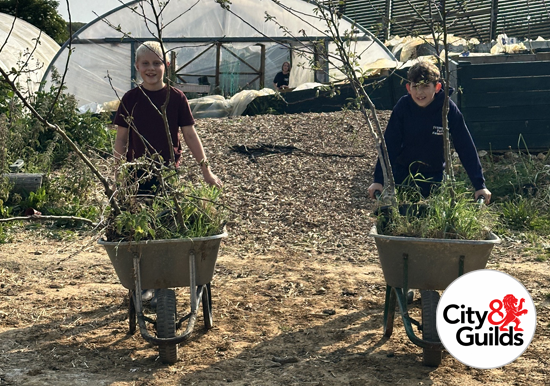
Develop introductory construction and woodworking skills through supervised projects in a real farm environment. Learners explore tools, materials, basic masonry, concrete and decorating while building confidence, teamwork and safe working habits.
Designed for learners aged 9 and above, with activities and support adapted to individual readiness and safety requirements.
Our Entry Level 2 Certificate in Skills for Working Life offers an introduction to practical land-based construction, including woodworking, masonry and decorating tasks. Learning combines supervised projects with short theory activities and essential workplace skills.
Recommended for learners aged 9+ who enjoy making, building and learning through practical activities. It can suit home-educated learners and young people who benefit from an alternative, supportive approach to education.
No previous qualifications are required. We consider each learner's ability to follow safety instructions, use tools appropriately and meet the assessment criteria with permitted support.
Successful learners may progress to Entry Level 3 construction, suitable Level 1 land-based studies or other vocational qualifications.
Our proposed unit combination develops practical skills alongside communication, safety awareness and digital confidence. The final selection is confirmed before enrolment.
Unit 201 – Workplace Safety and Emergency Procedures (1 credit): Understand everyday safety and emergency procedures.
Unit 203 – Identify Hazards in Familiar Settings (2 credits): Recognise hazards in the workshop and around the farm.
Unit 207 – Effective Communication (2 credits): Develop ways of sharing information and following instructions.
Unit 209 – Introduction to ICT (3 credits): Use basic digital skills for learning and simple projects.
Unit 237 – Maintain a Footpath (3 credits): Carry out suitable supervised outdoor maintenance.
Unit 263 – Mix and Lay Concrete (2 credits): Develop basic skills using concrete safely.
Unit 264 – Recognise, Use and Care for Woodworking Hand Tools (1 credit): Identify and look after suitable tools.
Unit 265 – Recognise and Cut Wood-Based Materials (2 credits): Measure and cut materials using appropriate methods.
Unit 266 – Use a Hammer and Nails in Wood-Based Materials (1 credit): Practise simple joining techniques.
Unit 267 – Use a Screwdriver for Joining Wood-Based Materials (1 credit): Join wood with screws.
Unit 268 – Use Sandpaper on Wood-Based Materials (1 credit): Prepare and smooth surfaces.
Unit 279 – Prepare a Work Area Ready to Commence Decorating (1 credit): Organise a safe workspace.
Unit 280 – Recognise and Care for Painting Tools (1 credit): Identify, use and maintain decorating equipment.
Unit 281 – Prepare a Surface for Decorating (2 credits): Prepare a surface for a suitable finish.
Projects may include simple wooden items, surface preparation, farm maintenance and outdoor improvements. Tasks are chosen to meet the relevant unit criteria and to suit learners' abilities and safe tool use.
Regular supervised practical sessions with short classroom activities, supporting teamwork, communication and confidence. Group availability and timetable are confirmed before enrolment.
Individual tuition allows activities and pacing to be tailored to the learner's confidence, safety awareness and support needs.
Suitable theory and ICT tasks may be completed remotely, with practical training and assessment taking place at the farm under appropriate supervision. Independent home study does not automatically count towards guided learning hours.
Assessment is through a portfolio of evidence, including practical observations, worksheets, photographs, discussion and completed project work. Practical skills are assessed in a realistic working environment, with learners required to meet the criteria for each unit.
Appropriate support and reasonable adjustments may be considered without changing the assessment standard. There is no single final written examination.
After completing this qualification, learners may be able to progress to:

Build on practical skills through more demanding supervised construction and woodworking projects.
Click to read more

Develop further land-based practical skills and safe working practices.
Click to read more

Build communication, teamwork and workplace readiness.
Click to read more

Practical Education Beyond the Classroom
Providing practical, farm-based education, recognised qualifications and alternative learning opportunities at Frampton Farm in Kent and Poppies Farm in Berkshire, helping young people develop confidence, independence and skills for the future.
Access course materials, complete theory activities and keep up with your learning using Moodle.
Download the Moodle app for your phone or tablet.


Fees & Funding
Course Fees
Fees depend on the learning centre, delivery arrangement and individual support required. City & Guilds registration and certification fees may apply. Costs and payment arrangements are confirmed before enrolment.
Privately Funded Places
Parents and carers can enquire directly, subject to availability and individual course suitability.
School & Local Authority Funding
Schools and local authorities may commission suitable placements as part of vocational education, alternative provision or an agreed EOTAS package. Funding must be agreed with the commissioning organisation.
Enquire About Fees
Please contact the relevant learning centre for current course fees and availability.